CNC Milling Explained: 3-Axis, 4-Axis, and 5-Axis Machining Guide
CNC Milling Explained: 3-Axis, 4-Axis, and 5-Axis Machining
Learn the differences between 3-axis, 4-axis, and 5-axis CNC milling. Understand which method is best for your part's complexity, tolerance, and budget.
Get a Free Milling QuoteCNC milling is one of the most versatile subtractive manufacturing processes. A rotating cutting tool removes material from a solid block to create precise, complex parts. But not all milling machines are the same. The number of axes determines what geometries can be produced, how many setups are needed, and the final accuracy of the part.
At Opicreate, our cnc milling services cover 3-axis, 4-axis, and 5-axis machining. This guide explains the differences and helps you choose the right approach for your project.
What Is CNC Milling?
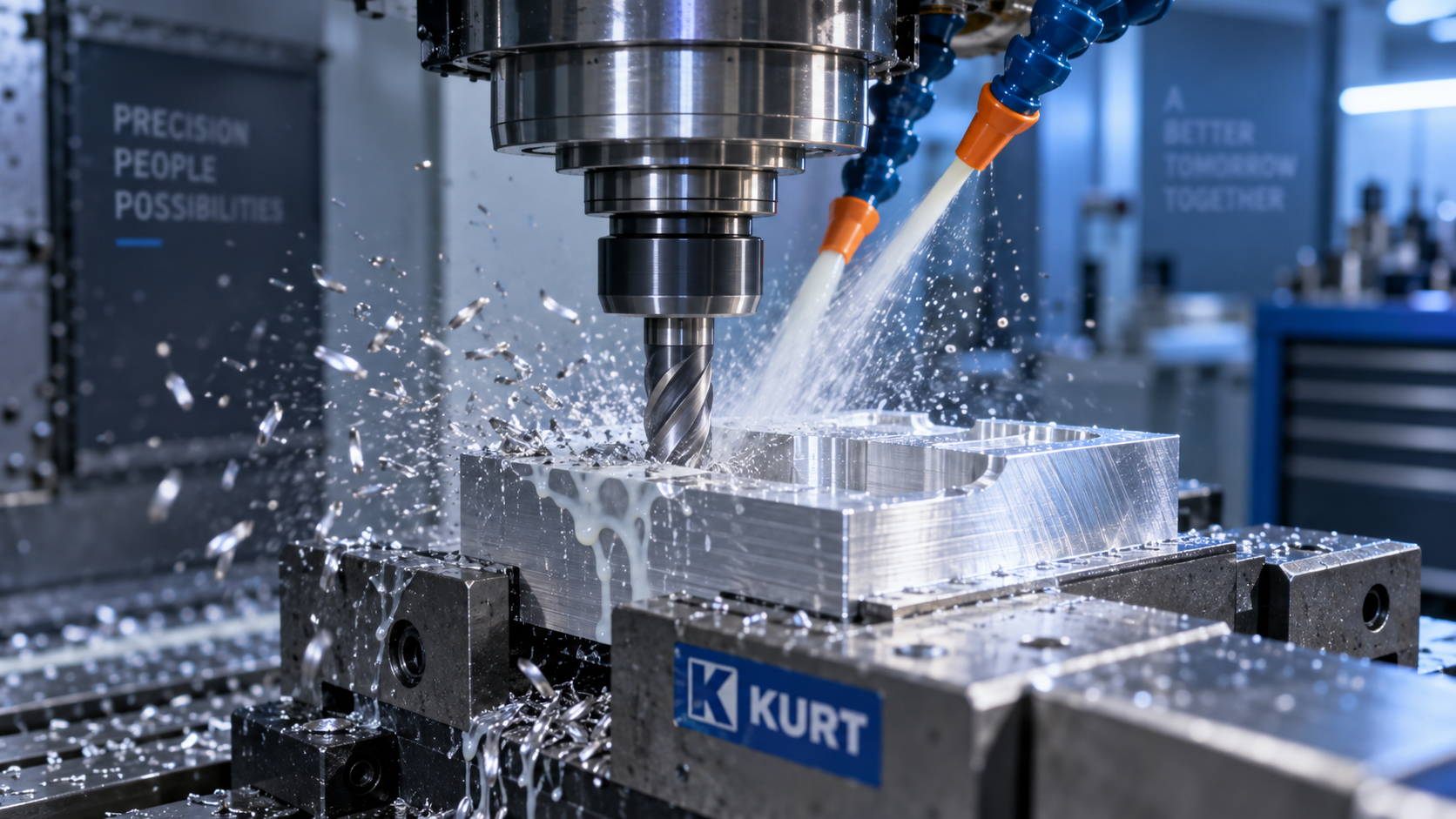
CNC milling is a machining process where a rotating cutting tool removes material from a stationary workpiece. The cnc milling machine follows programmed toolpaths to produce flat surfaces, slots, pockets, holes, threads, and complex 3D contours.
Unlike CNC turning, where the workpiece rotates against a stationary tool, milling keeps the workpiece fixed while the tool spins and moves along multiple axes. This makes milling ideal for prismatic parts, housings, brackets, molds, and components with mixed features.
Modern CNC milling machines can achieve tolerances as tight as ±0.005 mm and work with a wide range of materials including aluminum, stainless steel, titanium, brass, and engineering plastics.
3-Axis CNC Milling
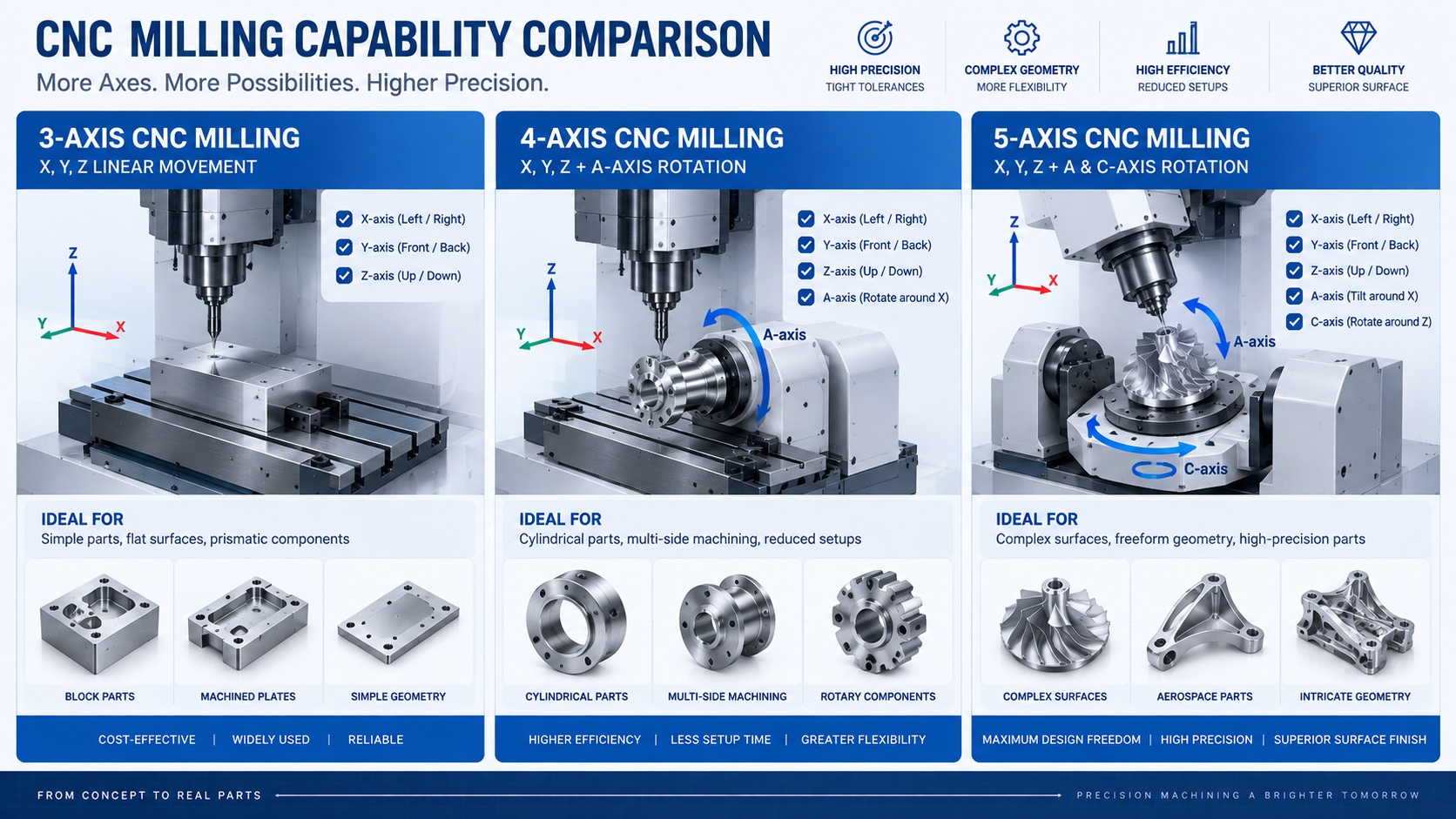
3-axis milling is the most common and cost-effective type of CNC milling. The cutting tool moves along three linear axes:
- X-axis – left and right movement
- Y-axis – forward and backward movement
- Z-axis – up and down movement
Advantages:
- Simple programming and fast setup
- Lower machine cost, reflected in more competitive pricing
- Ideal for parts with flat features and holes on one or two faces
- Excellent for prototypes and low-volume production
Limitations:
- Cannot machine undercuts or features on multiple sides without re-fixturing
- Difficult to produce deep, narrow cavities or unconventional shapes
- More setups may be required for complex parts, increasing lead time
If your part has simple geometry and only needs machining on one or two faces, 3-axis milling is usually the most economical choice.
4-Axis CNC Milling
4-axis milling adds rotation around one additional axis—typically the A-axis—which rotates the workpiece around the X-axis. This allows the machine to access multiple faces of the part in a single setup.
Advantages:
- Fewer setups, which improves positional accuracy and reduces lead time
- Can machine cylindrical features, angled holes, and wrapped profiles
- Ideal for parts like camshafts, gears, impellers, and multi-sided brackets
- Better surface finish on curved features compared to 3-axis with re-fixturing
When to choose 4-axis:
If your part needs features on multiple sides with tight positional tolerances, or if it has cylindrical or rotational elements combined with flat features, 4-axis milling offers a good balance of capability and cost.
5-Axis CNC Milling
5-axis milling adds rotation around two axes (typically A and C). The cutting tool or workpiece can tilt and rotate, allowing access to almost any angle in a single setup.
Advantages:
- Complex geometries, undercuts, and deep cavities machined in one setup
- Highest accuracy and surface finish for intricate parts
- Shorter lead time for complex parts by eliminating multiple setups
- Better tool life because the tool can be kept at optimal angles
Limitations:
- Higher machine cost, which is reflected in pricing
- Requires skilled CAM programming to avoid collisions
When to choose 5-axis:
If your part has freeform surfaces, undercuts, compound angles, or features that cannot be reached with 3-axis or 4-axis machines, 5-axis milling is the best—and sometimes only—option.
3-Axis vs 4-Axis vs 5-Axis: Quick Comparison
| Feature | 3-Axis | 4-Axis | 5-Axis |
|---|---|---|---|
| Axes of movement | X, Y, Z | X, Y, Z + A | X, Y, Z + A, C |
| Best for | Simple parts, flat features | Multi-sided parts, cylindrical features | Complex geometries, undercuts, freeform surfaces |
| Setups needed | 1–2 | 1 | 1 |
| Typical tolerance | ±0.01 mm | ±0.01 mm | ±0.005 mm |
| Cost | Lowest | Moderate | Highest |
Opicreate offers all three options. Our engineers will recommend the most cost-effective approach based on your design requirements.

Ready to Start Your CNC Milling Project?
Upload your drawing and get a free quote with DFM feedback. Fast lead times, competitive pricing, and one-on-one engineer support.
CAM Programming for CNC Machining: How Toolpaths Are Created
Related Article